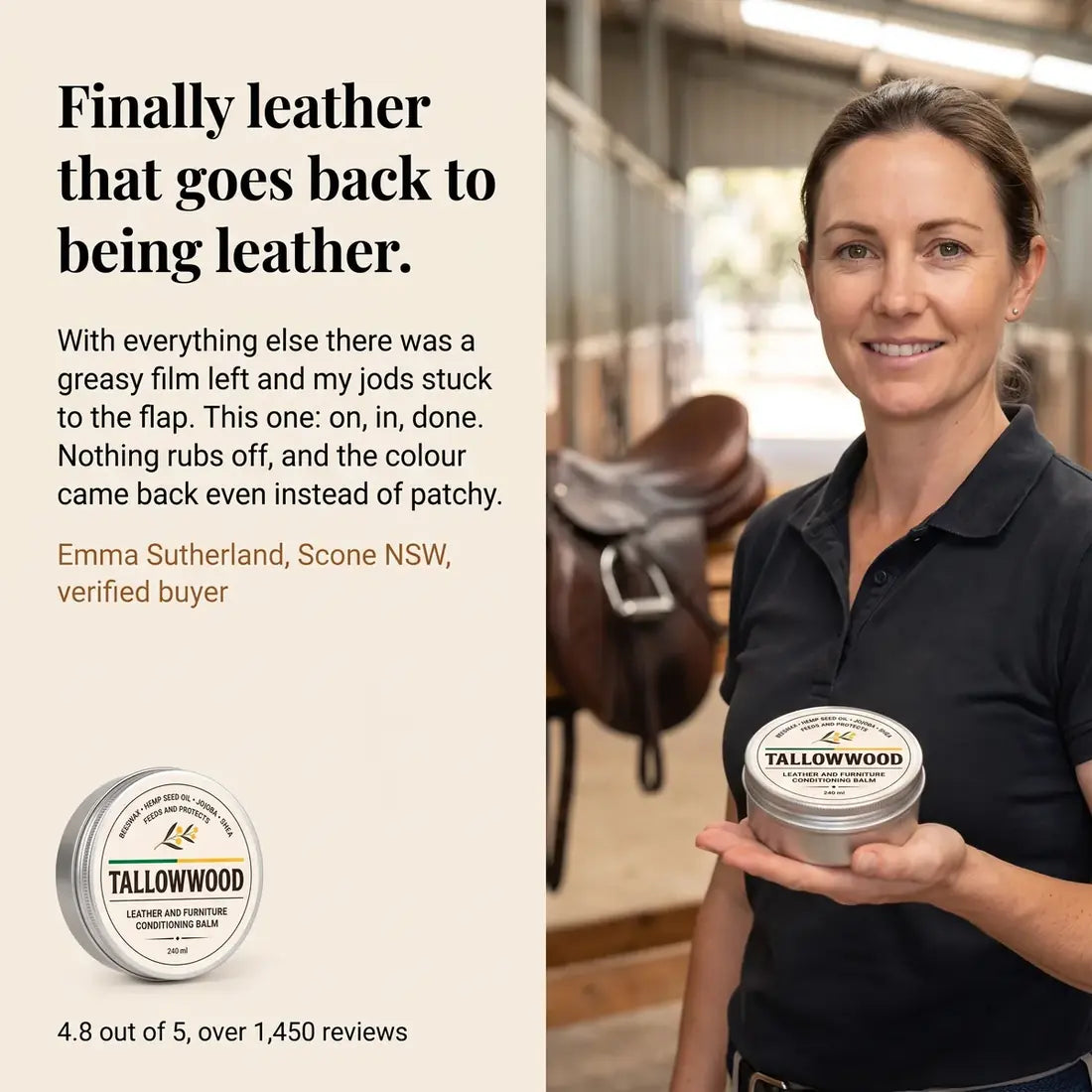
With everything else there’d be a greasy film left and my jods stuck to the flap. This one: on, in, done. Nothing rubs off, and the colour came back even instead of patchy.


Tallowwood, the saddler's balm for leather
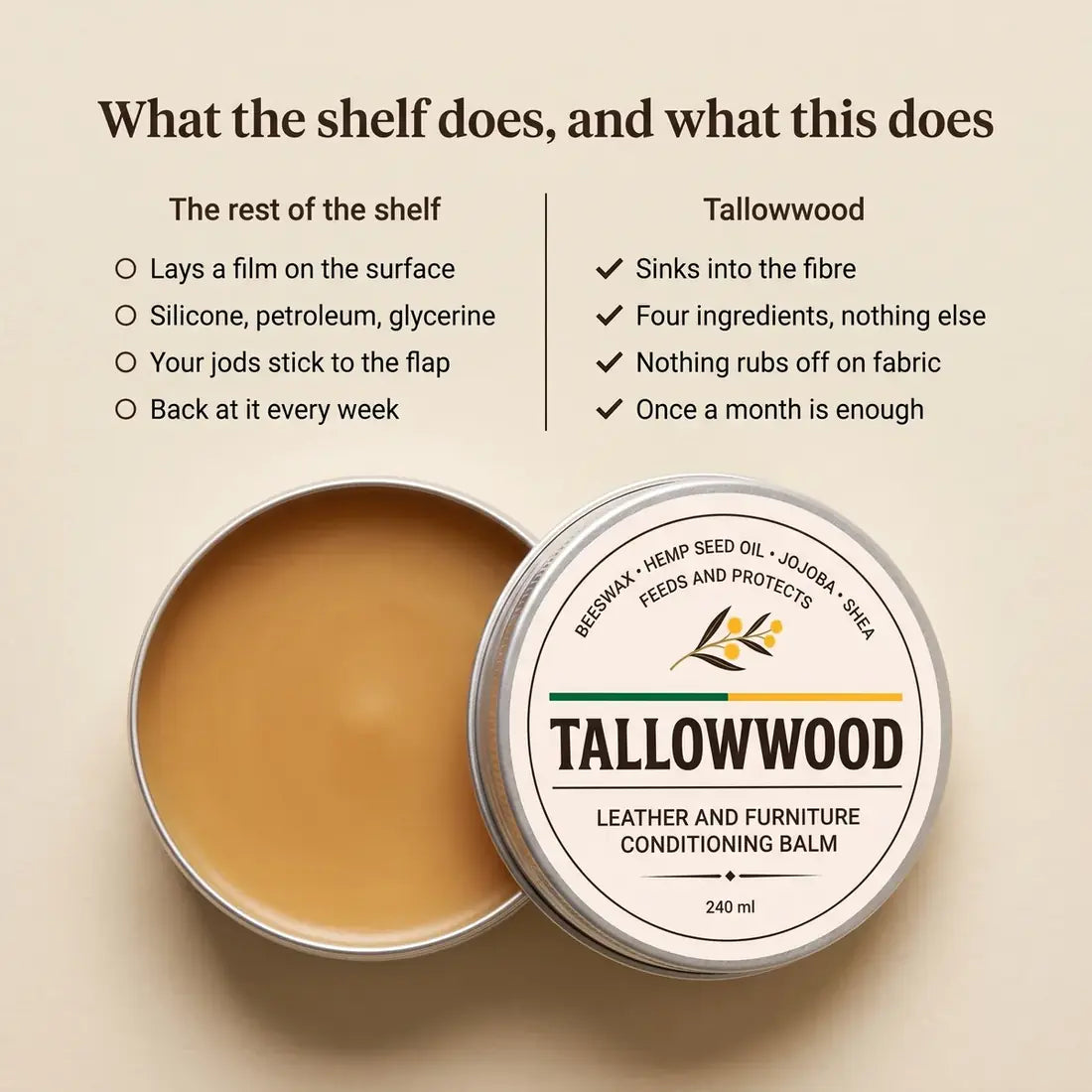
It feeds the fibre instead of sealing it. No greasy film, nothing that rubs off on your jods.
- Brings dry, tired leather back to life, from the saddle to the lounge
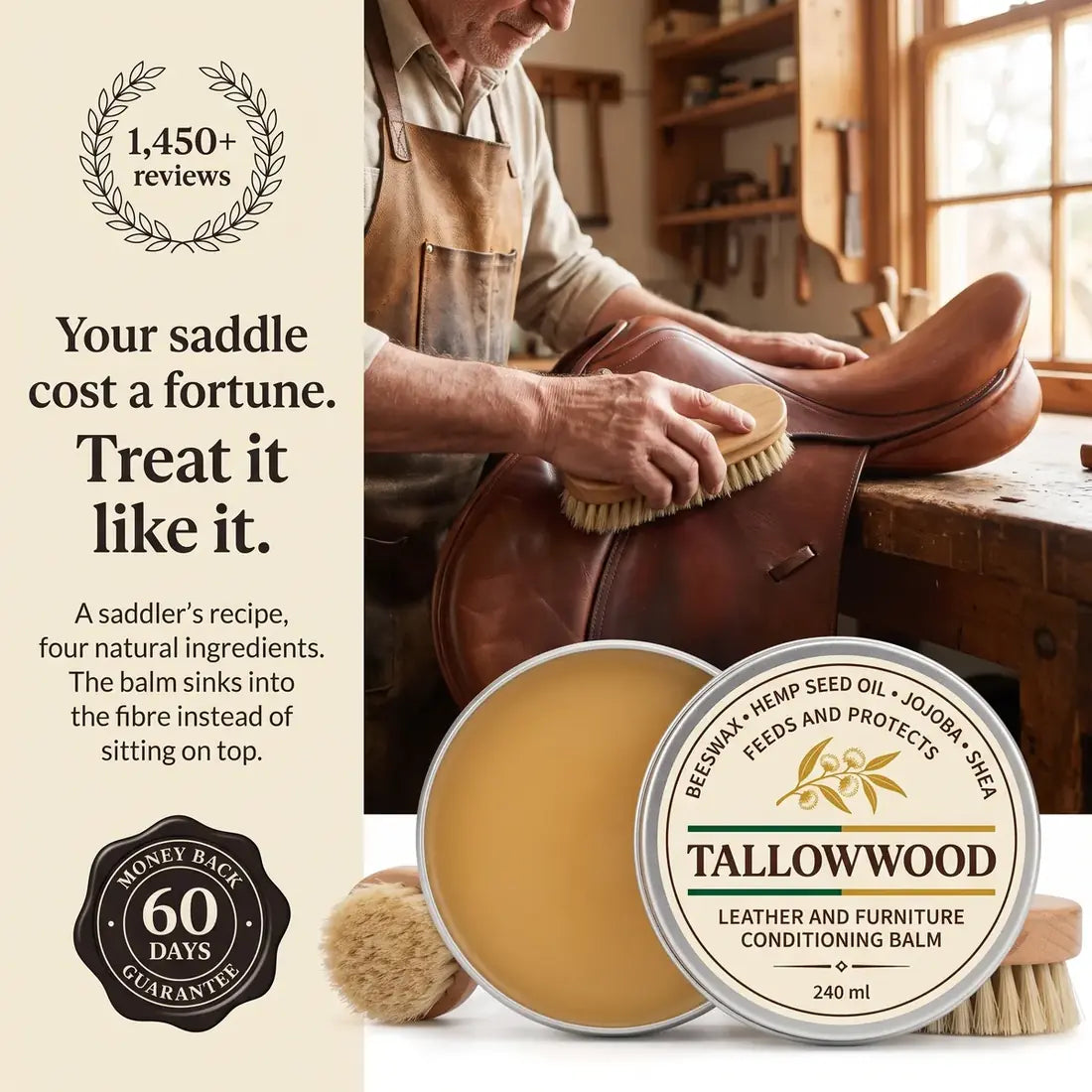
- A saddler's recipe out of a workshop in Scone, New South Wales
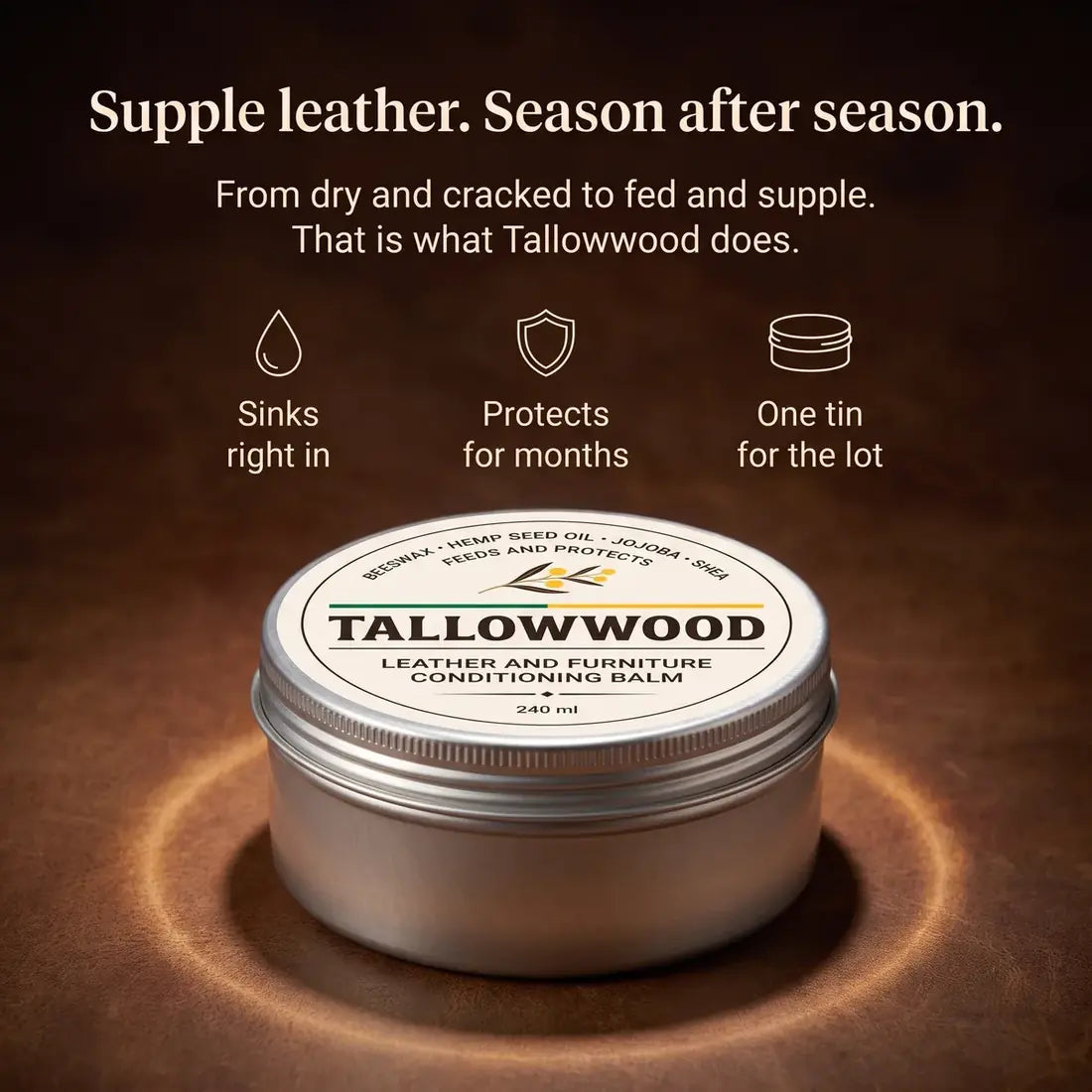
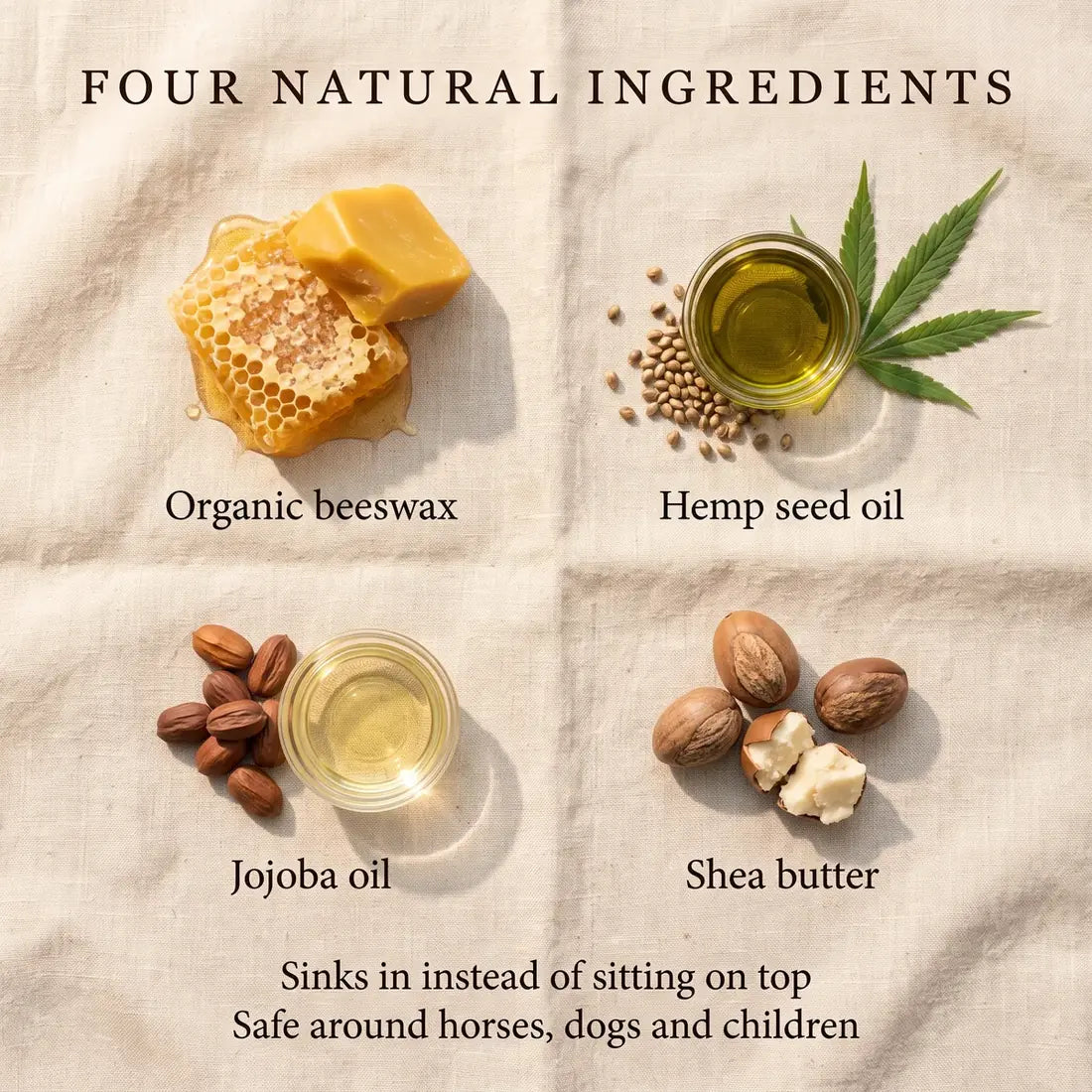
- Organic beeswax · Hemp seed oil · Jojoba oil · Shea butter
- 60 day money back guarantee, free delivery on orders over $75
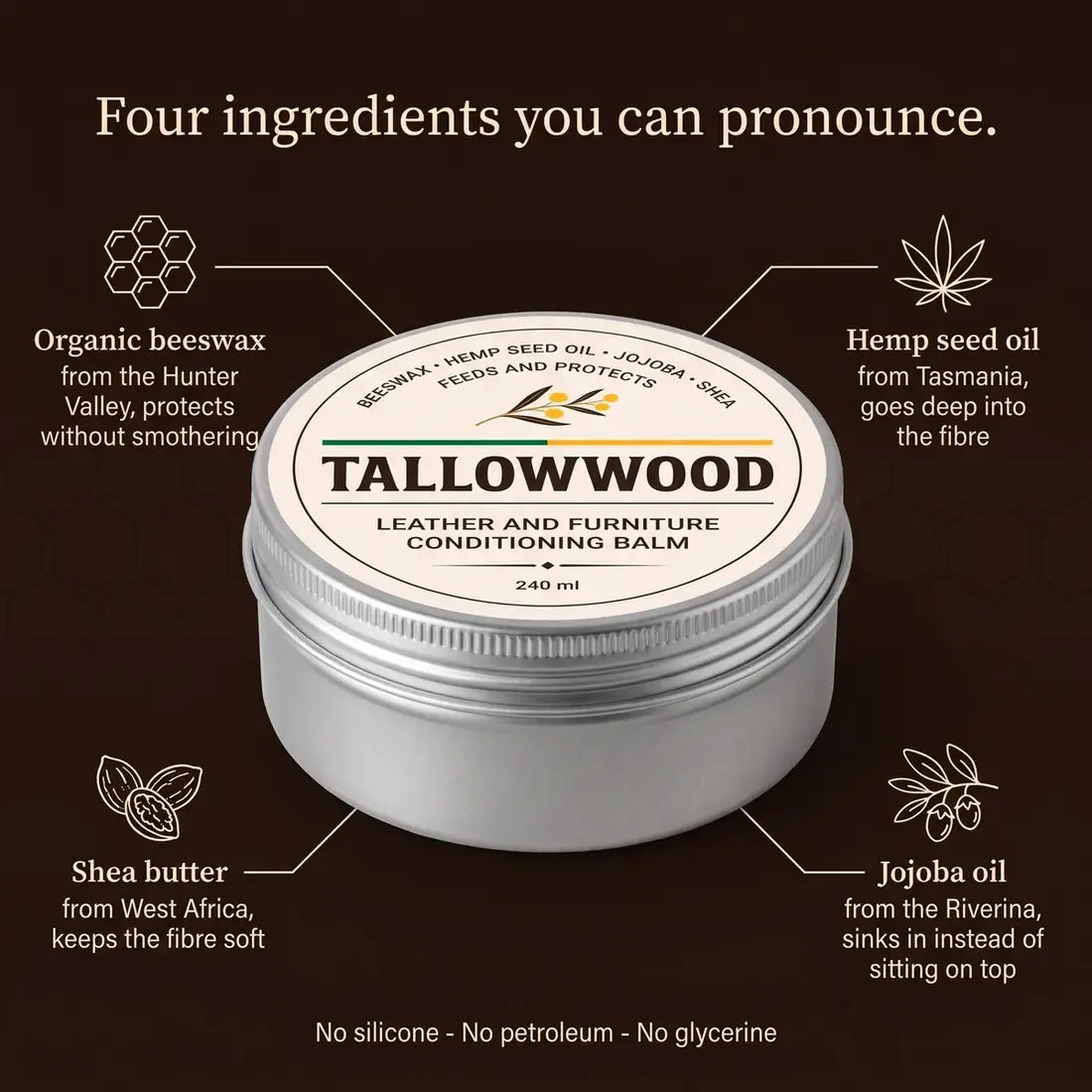
Four ingredients. The list fits on the lid.
- Organic beeswax, from the Hunter Valley. Protects the surface without smothering the fibre.
- Hemp seed oil, from Tasmania. Goes down into the fibre and gives it back its stretch.
- Jojoba oil, from the Riverina. Sinks in instead of sitting on the surface.
- Shea butter, from West Africa. Keeps the fibre soft and stops it drying out.
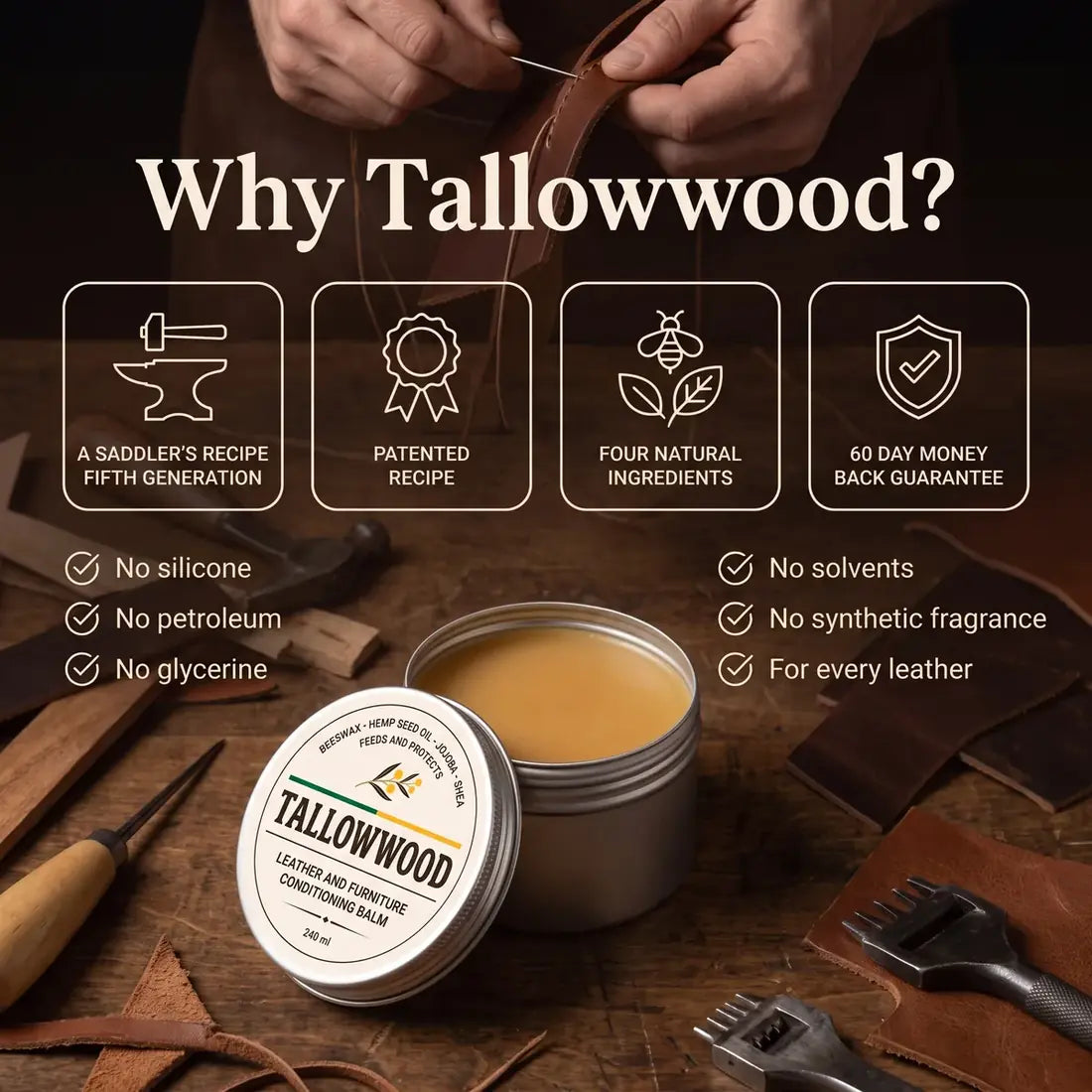
No silicone, no petroleum, no glycerine, no synthetic fragrance. No solvents either, so there is nothing in it you would not want near a horse, a dog or a child.
Your tack looks cared for. But is it?
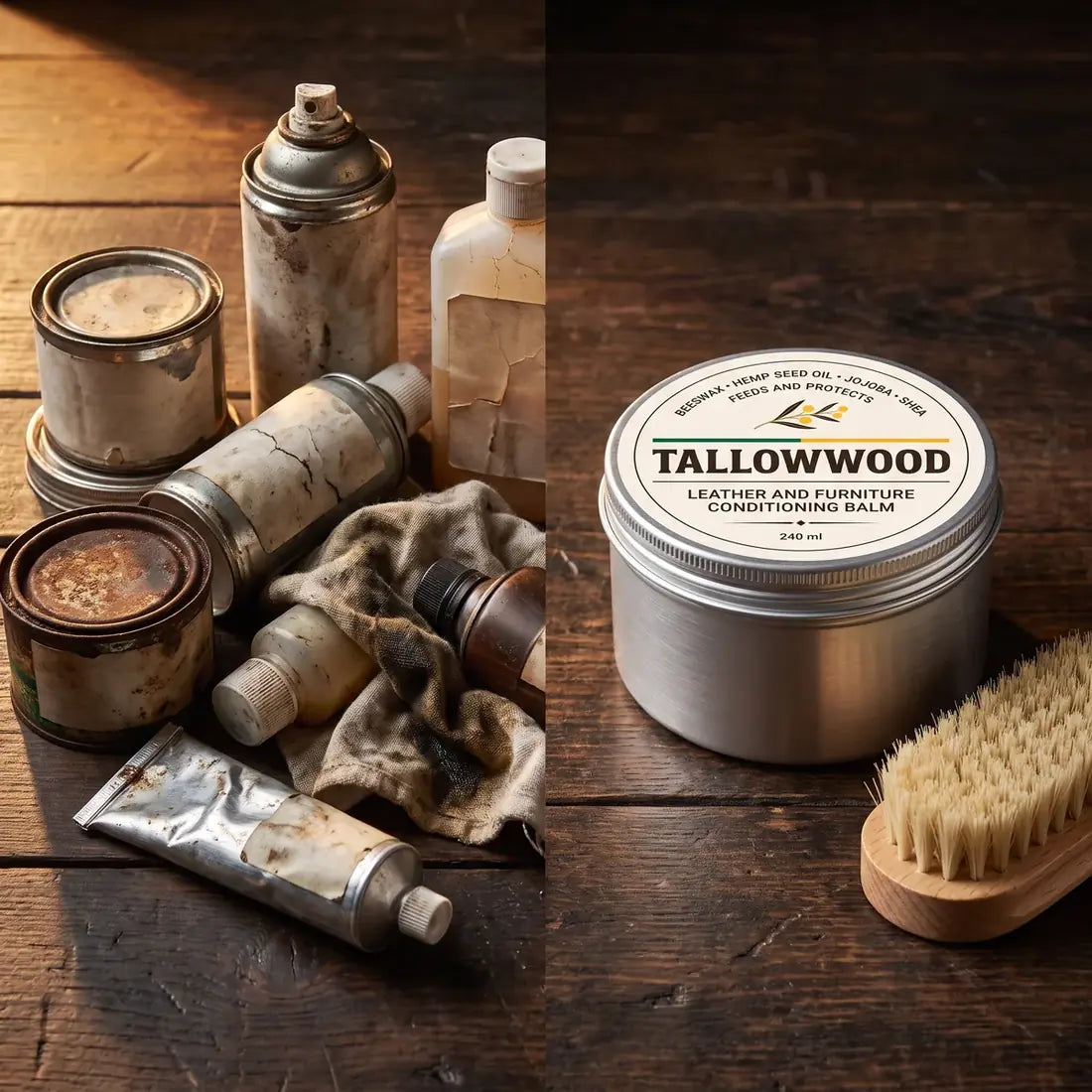
There are four bottles lined up in the tack room, and all four of them work against the fibre.
Glycerine soap cleans every week and strips the leather's own oils while it does it. Dubbin lays down a dense layer that smothers the fibre. Neatsfoot oil sits on the surface, sweats out in the heat and holds the dust. Waterproofing spray seals the lot with silicone, and after that the leather won't take anything at all.
The leather shines. It looks looked after. Under the surface the fibre hasn’t had a thing in years, and that is exactly where it goes hard and grey: under your knee, on the flap.
What customers write
Verified purchases, published as written.
My saddle had been creaking from the trot for months. Two goes six weeks apart and it’s gone. I didn’t think it was down to something that small.
The balm’s excellent. The round brush, I didn’t know what to do with it at first, and in the end that’s what spreads the coat most evenly.
Show the next morning and a dull saddle. One go in the evening, twenty minutes, and I left it alone. At the truck a mate asked what I’d put on it.
Saddle, bridle and boots out of the same tin. Before that I had three different bottles on the shelf and not one of them did the job.
The saddler this balm came from
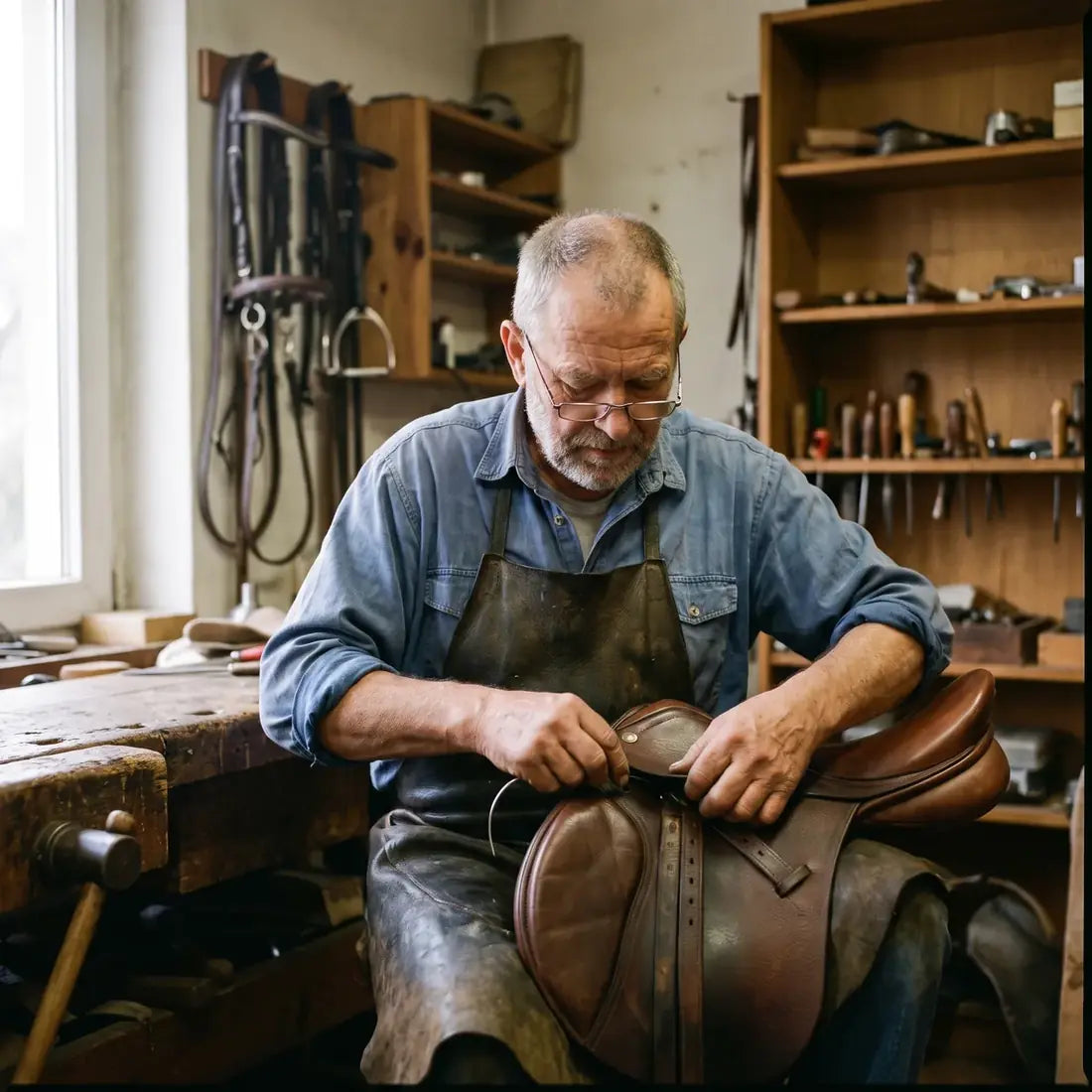
Ray Mullane is seventy two and works in Scone, in the same shed his great great grandfather stitched harness in. Fifth generation.
He knew for decades what leather care was doing to leather. He couldn’t build the alternative, because he is a saddler and not a chemist, and the ratio never came out right. It took him two years and forty seven batches. Number forty eight worked.
The breakthrough was not the ingredients. He had known those for years. It was the ratio. Beeswax protects without smothering. Hemp seed oil goes down into the fibre. Shea butter keeps it soft. Jojoba oil sinks in instead of sitting on top.
No silicone. No petroleum. No glycerine. No synthetic fragrance. Four ingredients, and that’s the lot.
One tin for the whole tack room.
Most riders have a shelf full of product. Glycerine soap. Neatsfoot oil. Dubbin. A different tin for every piece of gear.
Tallowwood replaces the lot.
- Saddles
- Bridles
- Stirrup leathers
- Reins
- Riding boots
- Half chaps
- Halters
- Show harness
- Your everyday saddle
- The leather lounge at home
That old saddle up in the shed, the one you’d already given up on: it gets a second go too.
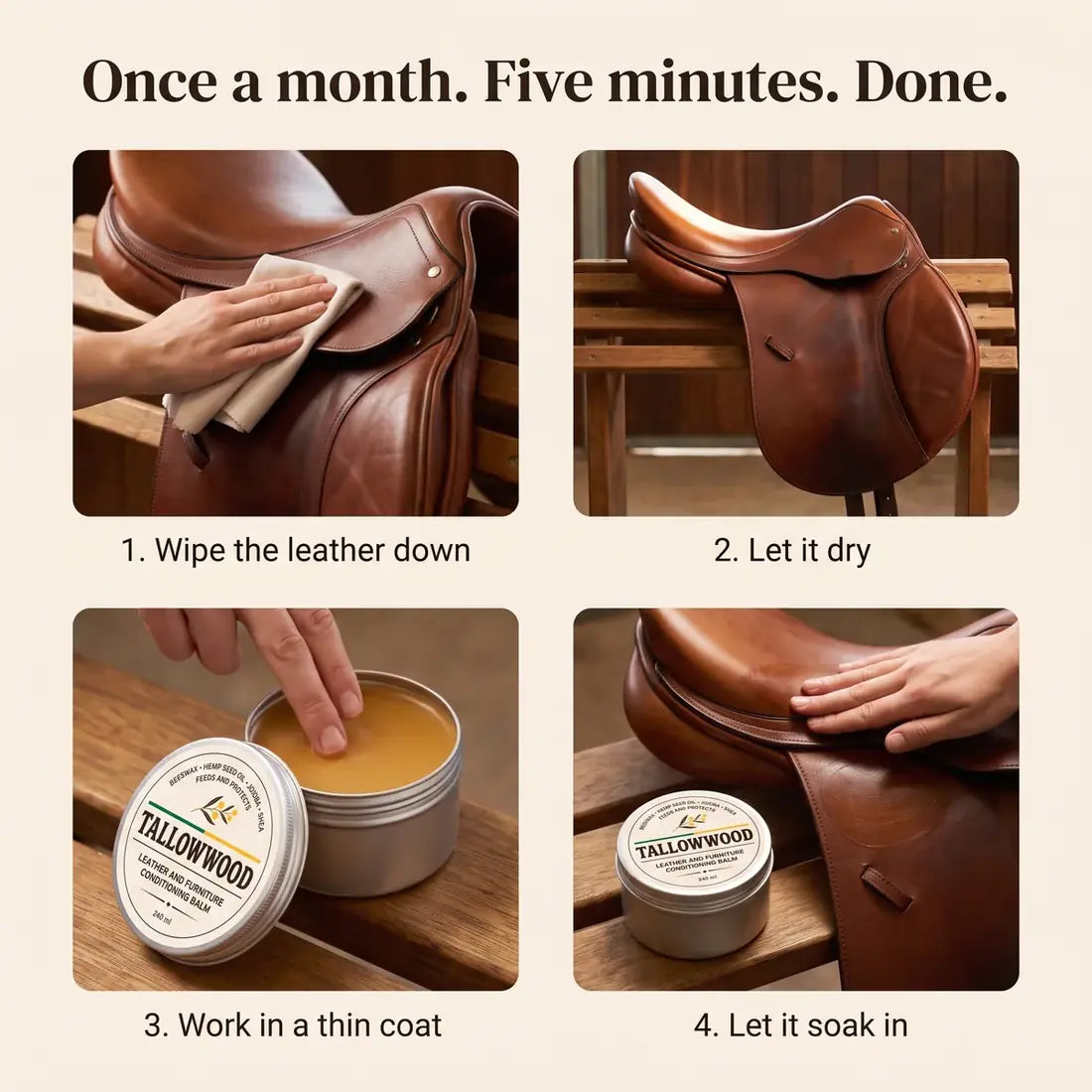
How to use it, in four steps
- Wipe the leather down
Arena dust, sand or the dust off the road comes off with a dry cloth or a brush. Never a wet cloth.
- Let it dry
The leather has to be dry to the touch, never damp.
- Work in a thin coat
A dab on your finger or on the brush, in small circles. Five minutes for a saddle, half an hour for a lounge.
- Let it soak in
The balm’s gone into the fibre in about two minutes. Give it twenty minutes before you use the leather again. After that it’s supple and nothing comes off on your hand.
Once a month for a saddle in daily work, every six to eight weeks if you ride on weekends. One 240 ml tin does a saddle, a bridle and a pair of boots for a year. Count on one tin for two goes over a three seater lounge.
How can a natural balm make that much difference?
Because it doesn’t do what the others do. Most products lay a coat on top of the leather. It shines on day one, then it dries, then it cracks, and the fibre underneath has had nothing at all.
Beeswax, hemp seed oil, jojoba oil and shea butter have molecules small enough to get in. The leather takes them the way skin takes a cream: it absorbs them, it does not wear them.
- No film, so nothing cracks at the fold
- Nothing rubs off on your jods or on the lounge
- The colour wakes up instead of being covered over
- The leather still breathes after you have fed it
You see it in minutes, not days
A saddle takes five minutes. You’ll see the difference before the tin’s back on the shelf.
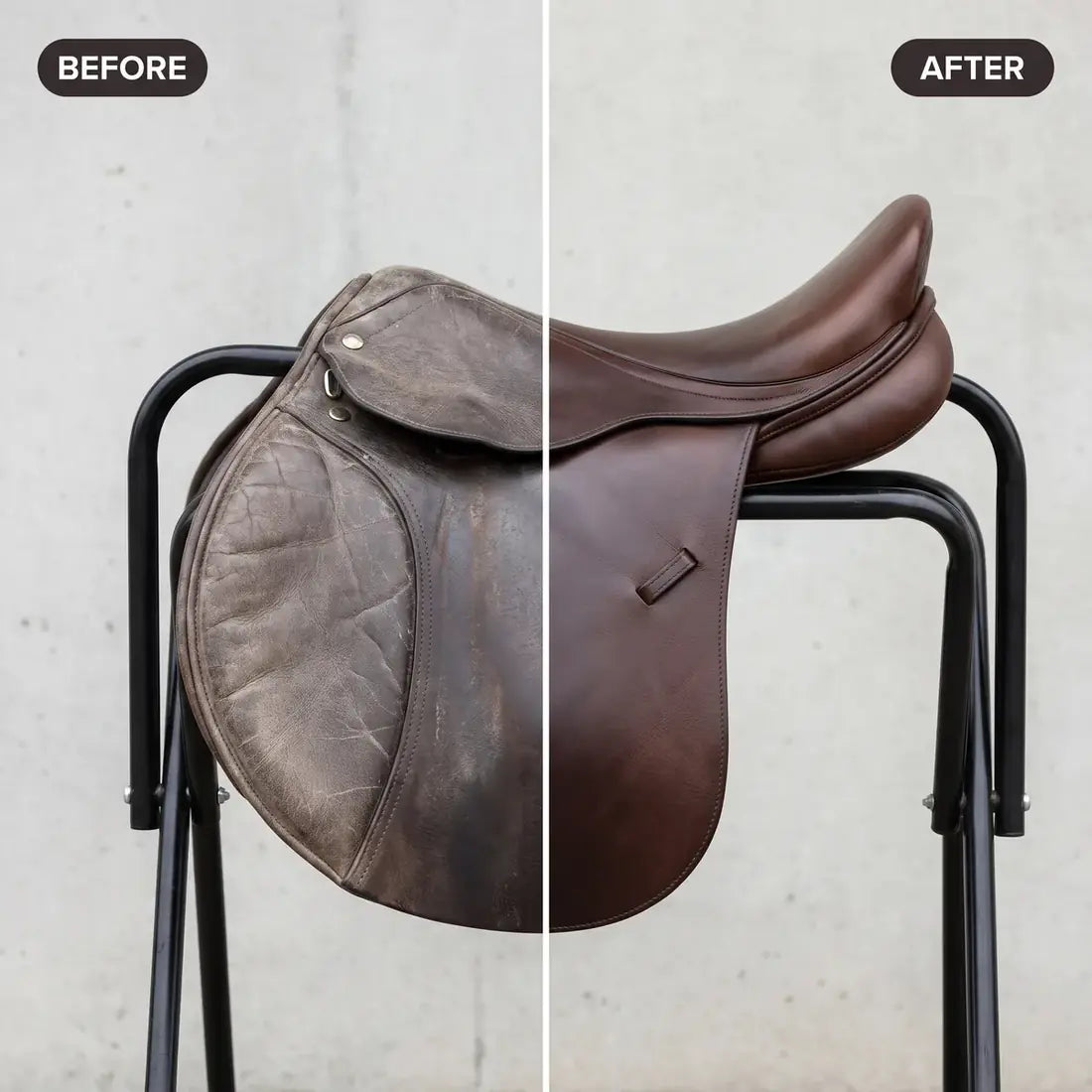
- Dry leather takes its colour back while you are still working
- The driest folds go supple after one go
- One treatment holds for about a month on a saddle in daily work
Try it with nothing at stake
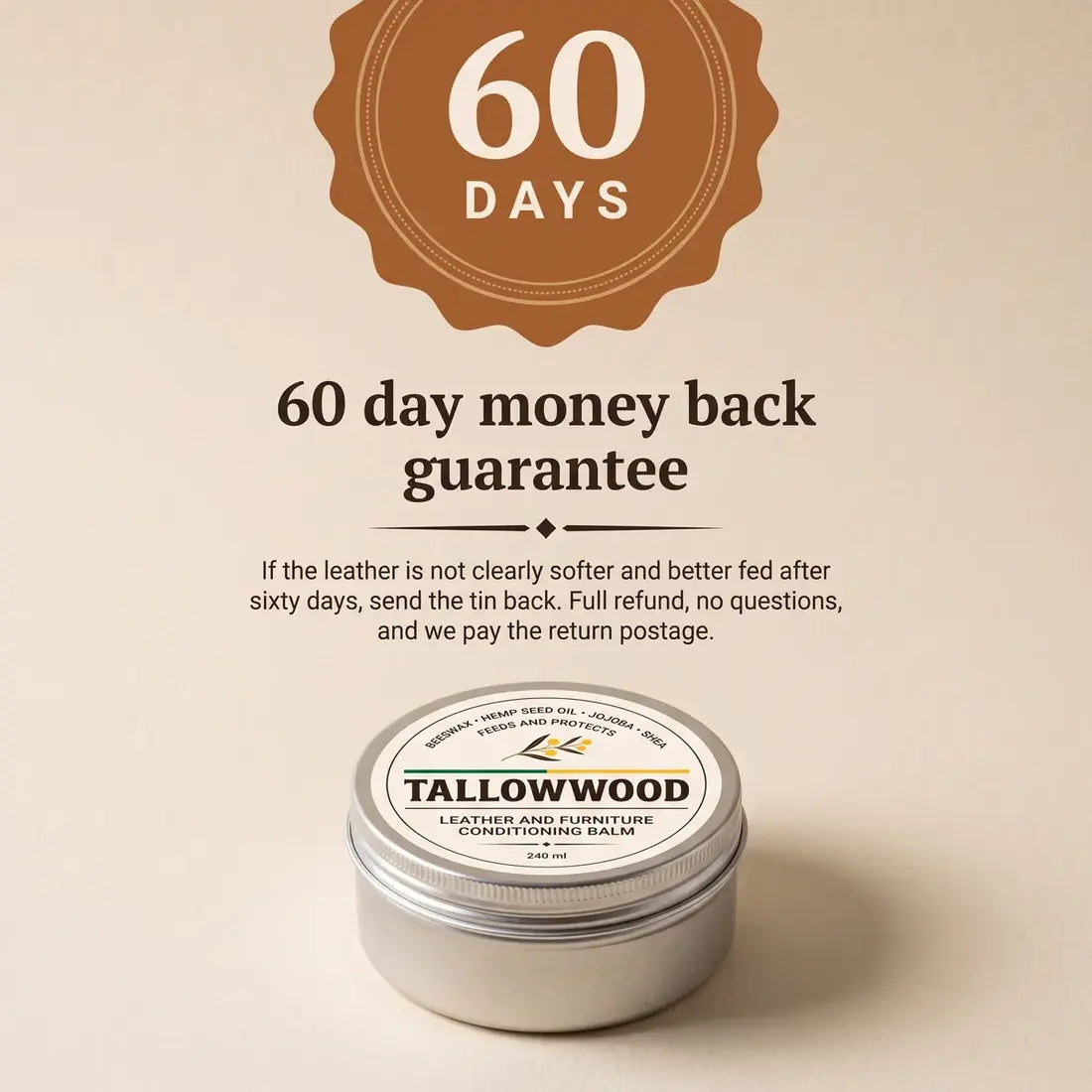
Email us at info@lederkur.de with your order number. We send you the return address and we pay the return postage, even if the tin is open and half used. The 60 days start the day your parcel arrives. This is our own guarantee and it sits on top of your rights under the Australian Consumer Law, it does not replace them.
What riders say
4.8 out of 5 · over 1,450 verified reviews
Old leather, very dry in places. Two goes a fortnight apart. The colour came back even, without the dark patches you get from oils.
It smells of beeswax and a bit of honey. After years of sprays that’s the first thing I noticed.
Easy to explain, hard to get wrong. A dab, rub it in, leave it. The kids manage on their own.
A twelve year old aniline lounge, the arms flat and rough. One tin for the three seater. It goes in, it does not stay tacky, and the colour went deep again instead of grey.
Three days out, two downpours. It’s not a waterproofer, but the leather was still soft when I got back and it hadn’t gone hard as it dried.
First time I used far too much. You need hardly any. Since then one tin lasts me the year on the saddle and the bridle.
Not overnight, that wouldn’t have been believable. After six weeks the area was the same colour as the rest again.
Frequently asked questions
What is actually in it?
Four ingredients and nothing else: hemp seed oil (Cannabis Sativa Seed Oil), beeswax (Cera Alba), jojoba oil (Simmondsia Chinensis Seed Oil) and unrefined shea butter (Butyrospermum Parkii Butter). No silicone, no petroleum, no glycerine, no preservative, no synthetic fragrance, no dye, no solvent. 240 ml in the tin.
Where does it come from?
The recipe is Ray Mullane's, out of his saddlery in Scone, New South Wales, and it is patented. It is mixed in small batches by hand, which is why the tins sell out now and again.
Will it help with mould on my tack?
It does not kill mould, and nothing that claims to will fix the cause. What it does do is leave nothing behind for mould to live on: glycerine and the residue from soaps and oils are what mould feeds on in a humid summer. Clean the mould off first with a dry cloth, let the leather dry properly, then feed it. Leather that is fed does not stay damp the way starved leather does.
Will it swab? I compete.
No. The hemp seed oil is cold pressed from the seed, and the seed carries no THC and no CBD. There is nothing in the tin on any prohibited substance list, and nothing in it is absorbed through the skin of a horse in any case, because it goes into the leather, not onto the animal. If your body has a rule about hemp derived products in the stable, check it, and we will send you the full INCI list for your file.
Which leathers can I use it on?
Smooth leather, greased leather, aniline and pigmented leather: saddles, bridles, stirrup leathers, boots, bags, lounges and armchairs. It is not for suede or nubuck, it would flatten the nap.
Does the leather go darker?
A little, and that is the sign it is working: the leather takes back the depth it had when it was still being fed. On very dry leather you will see the difference, but it comes up even, with no rings and no blotches, and nothing rubs off on fabric. Always try a hidden spot first: under the left flap on a saddle, under a cushion on a lounge.
How often do I need to use it?
Once a month for a saddle in daily work. Every six to eight weeks if you ride on weekends, and twice a year on a lounge. After a wet season, give it one extra go.
How long does a tin last?
One 240 ml tin does a saddle, a bridle and a pair of boots for a year. Count on one tin for two goes over a three seater lounge. If there are several riders in the house, or leather furniture as well, two or three tins is not stockpiling, it is one year’s worth for each of you.
Does it go tacky or greasy?
No. It is into the fibre in about two minutes. Give it twenty minutes before you use the leather again. An hour later a dry white cloth run over the area comes away clean.
Is it safe around my horse, my dog and my kids?
Four natural ingredients, no silicone, no petroleum, no glycerine and no synthetic fragrance. Shea butter comes from the nut of the shea tree, so if you have a known nut allergy do a patch test on the inside of your elbow first. Like any leather product, keep it out of reach of children.
How long does delivery take?
Standard delivery is $9.95, and free on orders over $75. We dispatch within 2 business days and your parcel arrives in 3-4 business days after dispatch. Express delivery is $14.95 and takes 1-2 business days. For regional and remote postcodes, please allow an additional 2-5 business days. You get a tracking number by email as soon as the parcel leaves us.
What if it is not for me?
You have 60 days. Email us at info@lederkur.de with your order number, we send you the return address and we pay the return postage. The tin can be open and half used. This guarantee sits on top of your rights under the Australian Consumer Law.